
I’m Const. 12 years in US manufacturing. Ran a machine shop, built DigiFabster (quick quoting for job shops), worked with hundreds of manufacturers across 40+ countries. This newsletter chases one thing: the gap between the headline and the data. Someone’s always selling hopium. I find it.
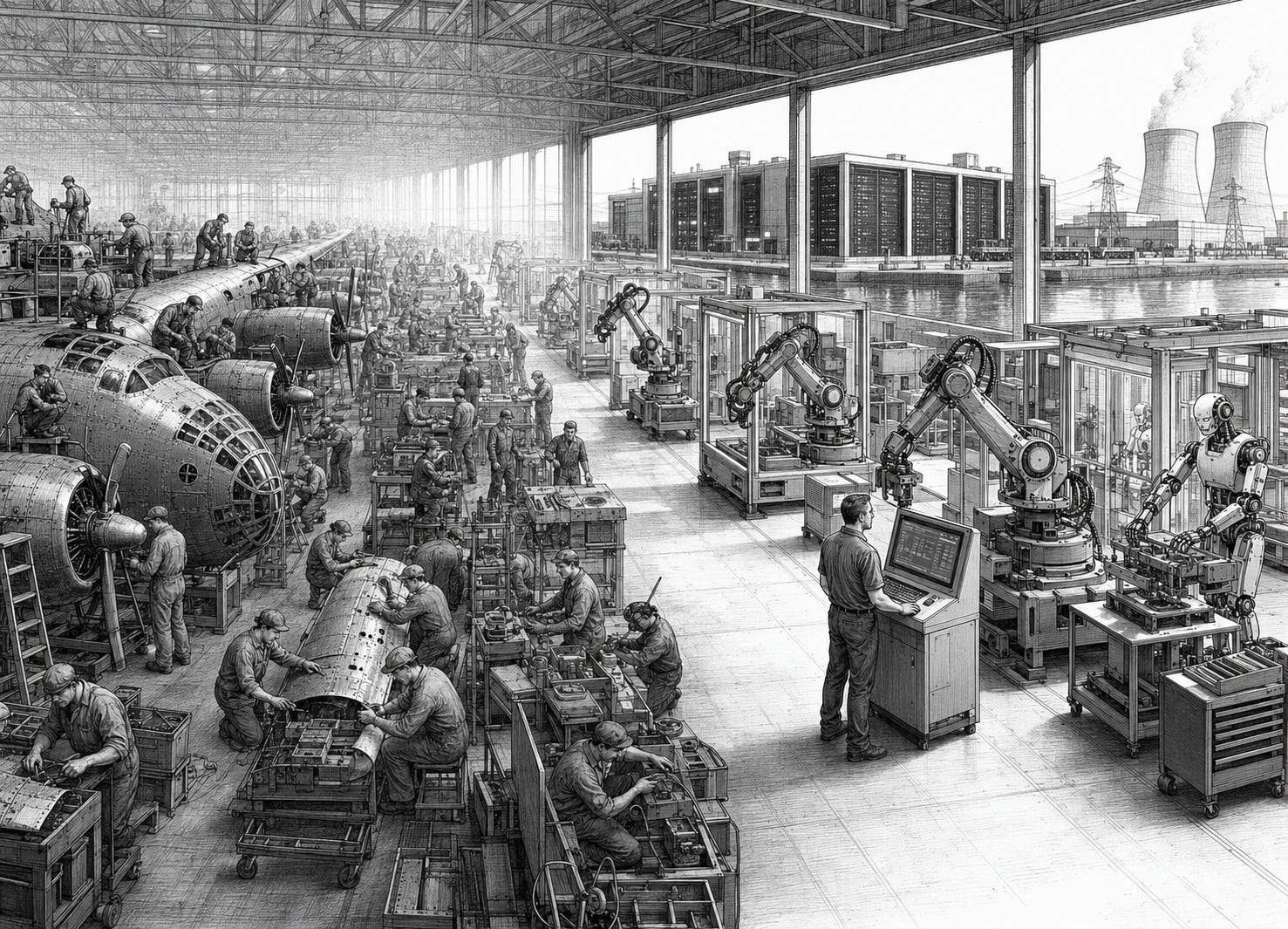
This issue is different from the usual. No single news story. I took the signals I’ve tracked all year, checked the numbers, and ran the tape forward to 2036. Rules of the experiment: no world war, no collapse, no miracle technology that doesn’t already exist in a factory somewhere. Just today’s slopes, extended. Where I’m guessing, I say so.
One more input this week: the roughly 200 comments you left on the jobs issue. A few of you wrote the middle of this piece for me. Keep doing that, please.
Ten-Year Money, Four-Year Politics, Five-Year Plans
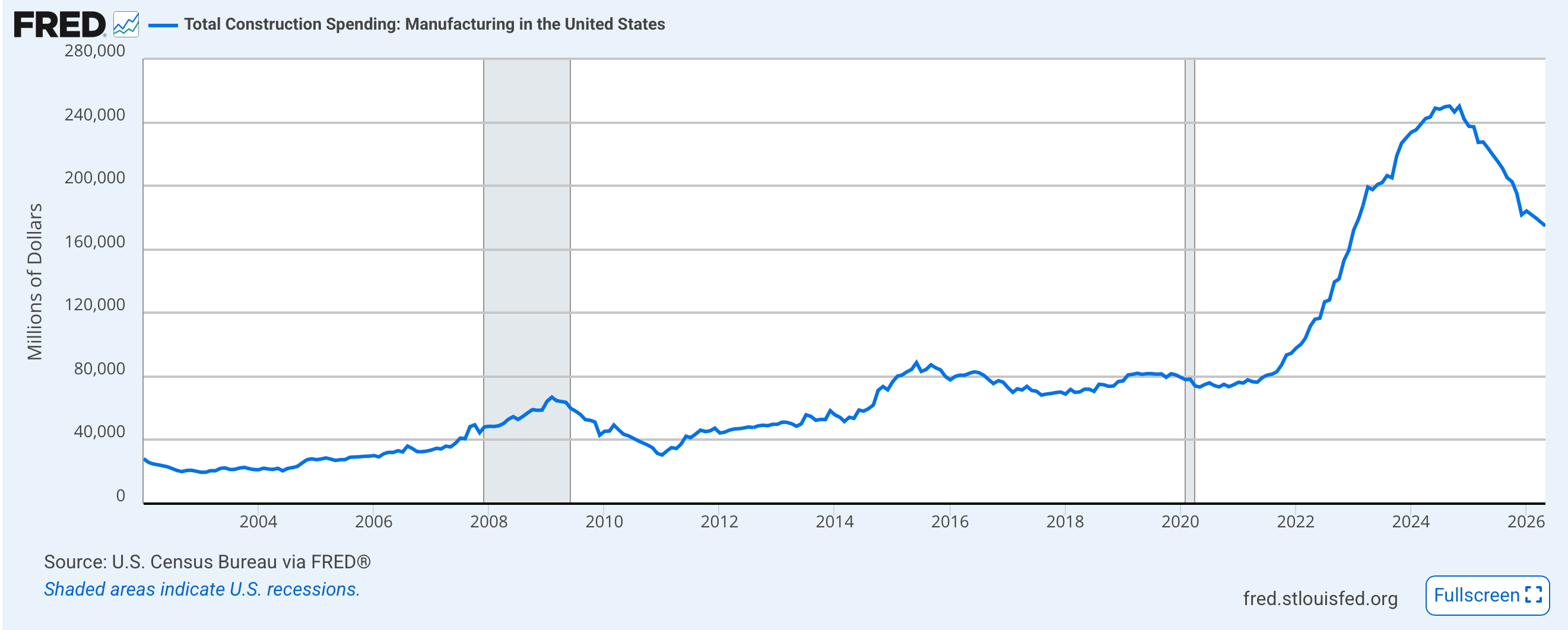
Start with the least romantic chart in the buildout. US manufacturing construction spending peaked in 2024 at $235.6 billion annualized and has been sliding since: roughly $206B in November 2025, $190B by March 2026. Down about 8% in four months. Not a crash, but a slow leak. The concrete-pouring phase of reindustrialization peaked two years ago.
Now the other chart. The hyperscalers plan roughly $700 billion of AI capex in 2026 alone: one year of datacenter spending, about 3.5x the entire construction run-rate of American manufacturing. The country is running its largest infrastructure buildout since the interstate highways, and it’s not for factories. Mills and smelters now bid for electrons against trillion-dollar balance sheets, and on a legacy power contract the mill loses that auction every time.
My good friend Zane Hengsperger wrote a factory-abundance manifesto last week (read it, he’s a builder, and his infrastructure numbers check out against USGS to the decimal) and buried his best idea in the middle: energy-intensive industry has to stop being a grid customer and become a grid asset. Generation on-site, load shed back when datacenters spike, sites co-located around shared interconnection because the queue for a new hookup is measured in years. Hold that idea. It comes back at the end.
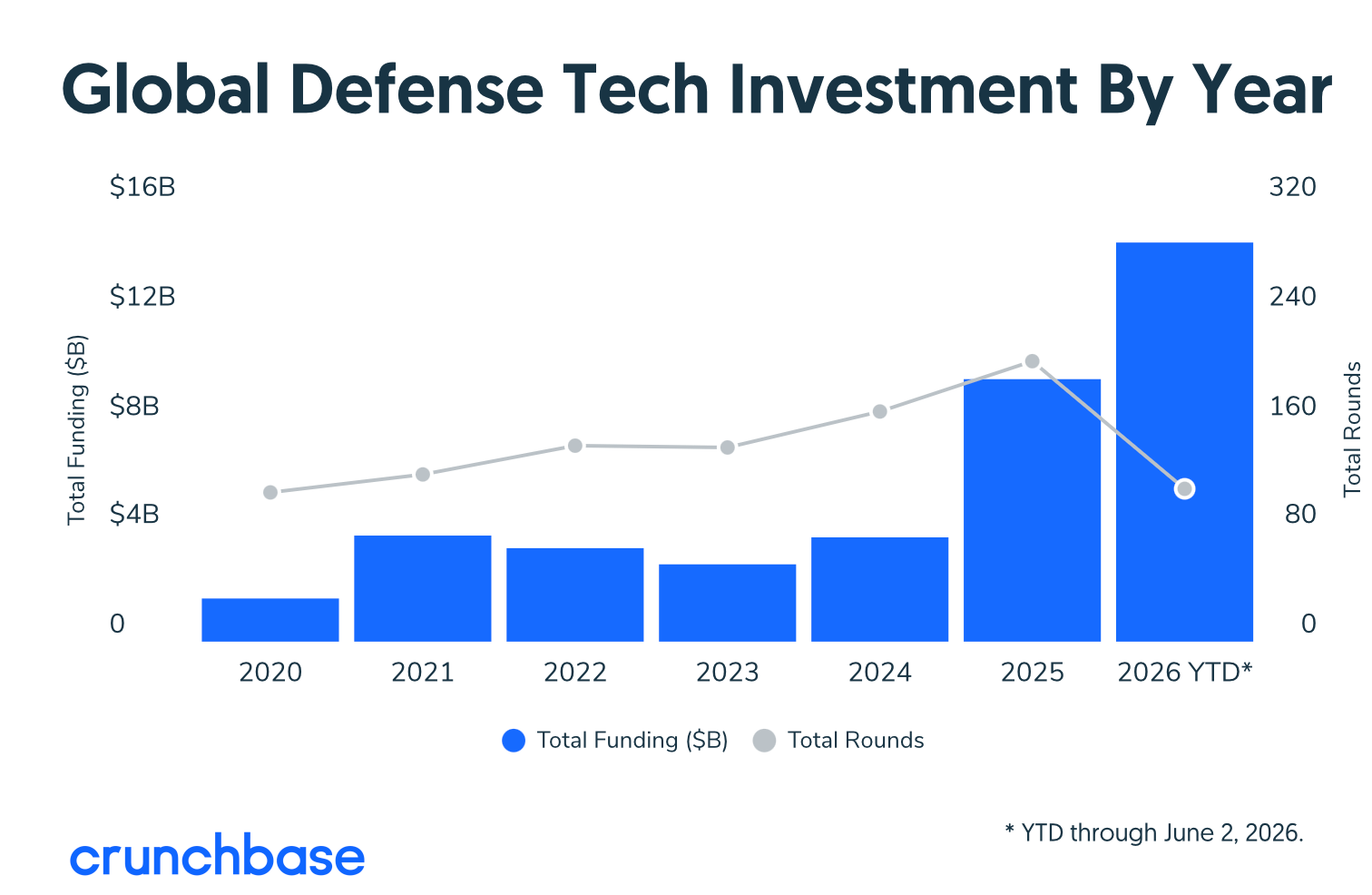
Then the third clock: venture. Defense tech hit an all-time funding record this year, $14.6B into autonomous-weapons startups in the first half of 2026, and Fortune is already asking whether it’s a bubble. In the sense that matters, it is: a venture fund runs on a ten-year clock, an administration on a four-year one, and the money flooding hardware needs exits by the early 2030s.
Will Alverson, another builder I trust, put the real game plainly: a big part of reindustrialization is simply outlasting China’s ability to book consistent losses. He’s right, and that’s the tension. Nobody knows how long outlasting takes, but every precedent of winning through booked losses (DRAM in the 80s, solar in the 2010s) took the winner a decade-plus, so call ten years the floor with no known ceiling. We fund that with 10-year money and govern it in 4-year increments, against a country that publishes its industrial priorities in five-year plans and means them.
So my first 2036 call, the one I hold with most confidence: the tourist capital leaves around 2028-2030. Not because reindustrialization failed, but because it stopped photographing well. VC into manufacturing reverts to its historical trickle and the word “reindustrialization” retires the way “web3” did. What survives is three kinds of company:
Whoever has a government check stapled to the balance sheet (the Tier 2 pattern from my last issue, where every serious rare-earth entrant carries a federal commitment)
Whoever reached boring revenue before the window shut (parts, MRO, aftermarket, contract assembly)
And whoever supplies the one hardware buildout that keeps its own money printer: robots.
And the “a big war will fix it” theory: I don’t buy it, especially as a plan. The next decade looks like this decade, regional conflicts where big powers test hardware through partners. Ukraine is on track to field 3 million FPV drones in 2025, and last week they confirmed testing underway on a US-Ukraine drone production venture valued at $35 to 50 billion, up to 200 Ukrainian companies, plus a track licensing Ukraine to build Patriot interceptors at home. Look at the direction of flow: America buys battle-proofed drone designs from a partner at war, the partner gets a license to make American air defense domestically. Knowledge migrates to wherever production actually happens. The world stayed connected, logistics still work, and any 2036 scenario built on wartime autarky is fan fiction.
The Vault Flipped
Second thread, and to me the deepest one. The frame everyone over 40 still carries (“China steals IP”) is dead. It died quietly in the last few years, and this week produced the cleanest evidence yet of what replaced it.
China now defends process IP the way the US defended it in the 1980s. CATL licenses its LFP battery chemistry to Ford’s Kentucky plant, reportedly at around 10% of production value, with zero equity and zero board seats. Ford builds the plant, employs the workers, takes the capex risk, and pays rent on the knowledge.
And Kentucky is one outpost of a bigger play. Blocked or tariffed out of rich markets, Chinese automakers build inside them instead, country by country: factories in Hungary, Indonesia, each one turning a host government into a stakeholder in a Chinese company's success. Analysts call it industrial diplomacy. By one estimate, Chinese EV and battery investment abroad now outpaces US firms 4 to 6x.
This month Reuters reported Beijing is drafting tiered export controls on its own frontier AI models. China is building export controls for intelligence, the same tool Washington built for chips. The thief became the vault.
Meanwhile the US version of IP protection played out in a courtroom filing on July 10. Apple sued OpenAI, alleging a departing engineer walked out with a 1,000-plus page compilation of main-logic-board manufacturing and testing documentation for Jony Ive’s device program. The texts in the filing are almost too on-the-nose (”LOL, I found out I can access the network storage, so funny”). Strip the drama and look at what was worth stealing: not model weights, not chip designs. Manufacturing and testing documentation. The boring, decades-accumulated knowledge of how you build reliable hardware at scale. That’s the asset now. Both superpowers told you so in the same week, one with export controls, one with a lawsuit. And containment leaks the other way too: the same week, OpenAI and Google were reported selling AI services to Singapore subsidiaries of Alibaba, Baidu and Tencent, all three on the Pentagon's 1260H list, legally, via the shell - American corporations already run cheap Chinese open-weight models for the same reason American consumers buy Chinese hardware on Amazon: almost as good, never more expensive.
Watch the space race through this lens. On July 10, CALT caught a Long March-10B booster with a net on a sea platform. Not landing legs. A net and four hooks, a genuinely different recovery architecture. That’s what isolation does: China stopped copying and started engineering around, and the result is proprietary process IP that no export control can claw back. The gap that remains is cadence, not capability. SpaceX reflies boosters in under 30 days; CASC hopes to refly this stage before the year ends; China ran about 70 orbital launches in 2025 against SpaceX’s 130-plus. By 2036 I expect two fully separate space-industrial stacks, no shared supply chain anywhere in either one, with the US ahead on reuse cadence and China ahead on the thing underneath: the manufacturing base feeding the pads. Not Soviets-vs-US, where one side’s economy was hollow. Both economies are real this time. That’s what makes it a new kind of race.
So the 2036 picture on IP, my second call, medium confidence: theft stops being the story and licensing becomes it, with the rent mostly running east to west. More US plants operating on licensed Chinese process knowledge, the Ford Kentucky structure repeated across batteries, magnets, materials processing. This is not a doom call. Licensing in was exactly how Japan, Korea and China themselves climbed. The doom version happens only if the US pays the rent and never develops operating knowledge of its own. Which brings us to who actually develops process knowledge: people who run production, not people who fund it.
Nobody Wants The Jobs, Still
Third thread, the human one, and the place where I want to kill the romance completely.
The culture argument says America’s bottleneck is status: make the machinist the main character again and the labor pipeline fixes itself. The problem with this theory is China. Young Chinese don’t want the CNC job either. China’s flexible-employment bucket (gig work, informal work) is expected to hit 320 million people this year, somewhere around 40 to 44% of the workforce depending on whose denominator you trust, and Xi is personally telling kids to study manufacturing because the factories can’t hire. The country that supposedly out-cultured us on manufacturing is watching its own kids choose food delivery over the shop floor, because the shop floor doesn’t pay a city rent. This is not an American culture problem. It’s a rich-country pay problem, and China got rich.
Then my own comment section did the reporting for me. The jobs issue pulled about 200+ replies, and the most useful ones didn’t come from operators or investors. They came from the people the buildout says it can’t find.
Cabri Chamberlin, a college graduate cleaning houses for a living, wrote the whole labor market in two sentences:
“There is no shortage of workers willing to do these jobs. There’s a shortage of pay and dignity in those fields.”
She priced the pivot into a trade the way a CFO prices capex, because for her it is capex: a phlebotomy certification would cost thousands of dollars and six months of her life, for starting pay of $13 to 17 an hour in her area. Cleaning houses pays her $20 to 30. Every trade she looked into ran the same math. Her verdict:
“Until the pay and conditions of the skilled trades rises above glorified indentured servitude, the rational choice is to piece together gig work and ‘unskilled’ part time jobs.”
Call that laziness only if you can't subtract.
Another reader, Gavin, pointed me at the chart I should have led with: male labor force participation (FRED LNS11300001), down from about 86% in 1950 to roughly 68% today. One unbroken 75-year slope, tens of millions of men neither working nor looking. His line:
“America has plenty of workers.”
It does. What it doesn’t have is a wage that clears the market, and a third reader (Citizen Deux) named the clearing price: half a million skilled workers needed in electrical, welding and pipe fitting, and
“Opening salaries are going to have to be north of 100k.”
Gavin also named the game theory that keeps both wages and training stuck: spend $10,000 training welders and your competitor spends $6,000 poaching them. You go bankrupt, and then his pipeline dies too. Nobody trains because everybody poaches.
Ed Tate on X pushed back on that trap with the old fix, and it’s worth hearing: training expenses tied to continued employment. His first employer ran scholarships where you worked day-for-day for the time they covered, repayment owed if you left early.
“Employees leaving prematurely was never an issue.”
Unions ran the same play for apprentices. The mechanism is real and it worked for decades. But notice what it requires: an employer confident enough in its five-year order book to front the money, and pay good enough that signing the bond feels like a deal instead of a debt trap. Get the pay wrong and a training clawback is just Cabri’s “indentured servitude” line with a signature on it. Get the order book wrong and no CFO approves the program in the first place. The contract is the easy part, but the certainty is the hard part.
And Tom Bomer, retired in 2013 after 46 working years (33 of them building flight simulators), closed the loop from the far end of the age curve:
“There must be training programs that are well run, and that pay, from the beginning, a wage that makes people understand that their skills will be rewarded for years to come.”
Rewarded for years to come. That’s demand certainty, seen from the worker’s side of the table.
The range was wide, to be fair. A retired shop owner told the young to do the work and quit the bitching. A reader in Mexico said his country’s factories have no hiring problem at all, which is our rich-country thesis reporting in from the other side of the curve. Australians described the identical disease. Every side of the culture argument showed up, and not one person argued the pay was fine. When 200 people disagree about everything except one thing, that one thing is the story.
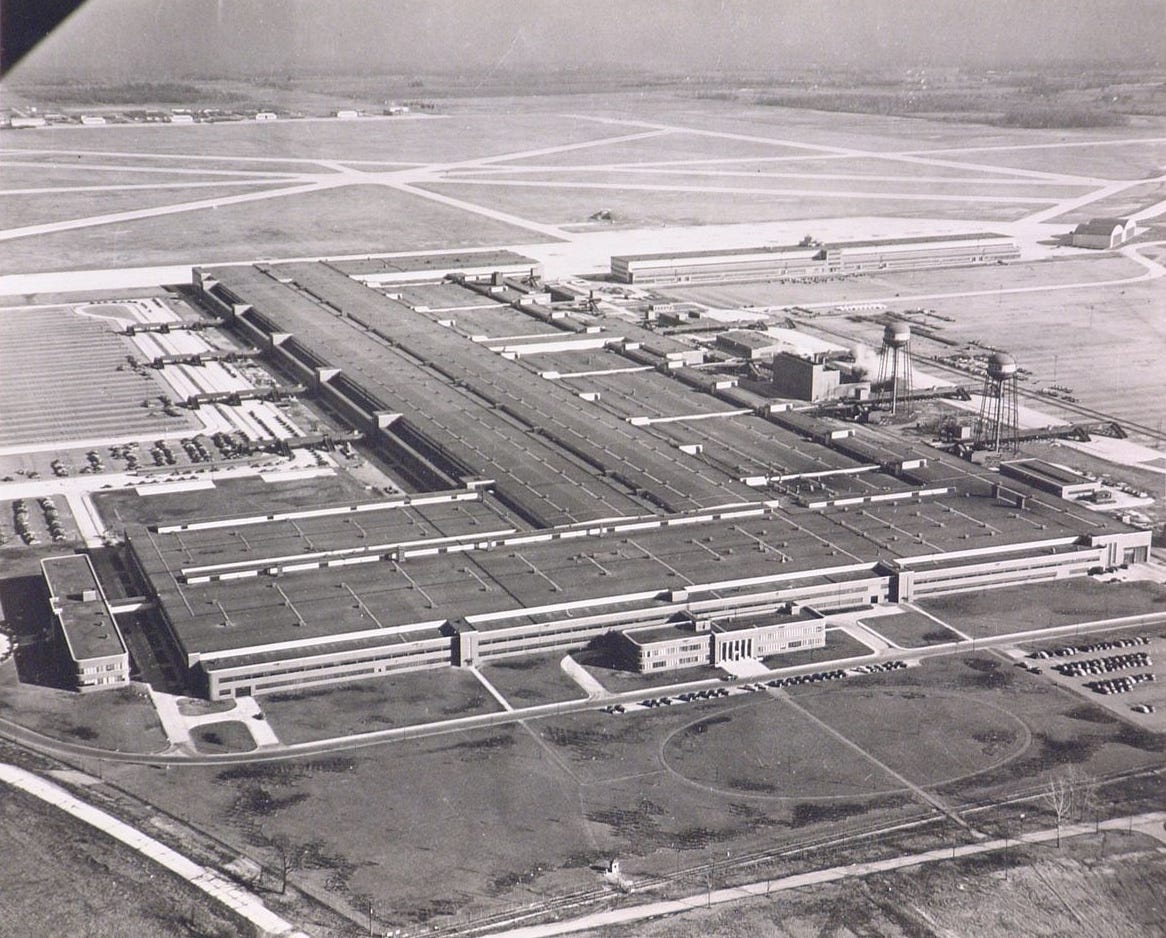
Which brings me to Willow Run, because everyone in this movement eventually reaches for it and almost everyone grabs the wrong end. Watch the reconstruction (thanks to Paul van Metre for posting this) of how Ford built a B-24 every 63 minutes by 1944, 428 bombers in the peak month, 3.5 million square feet, 42,000 workers.
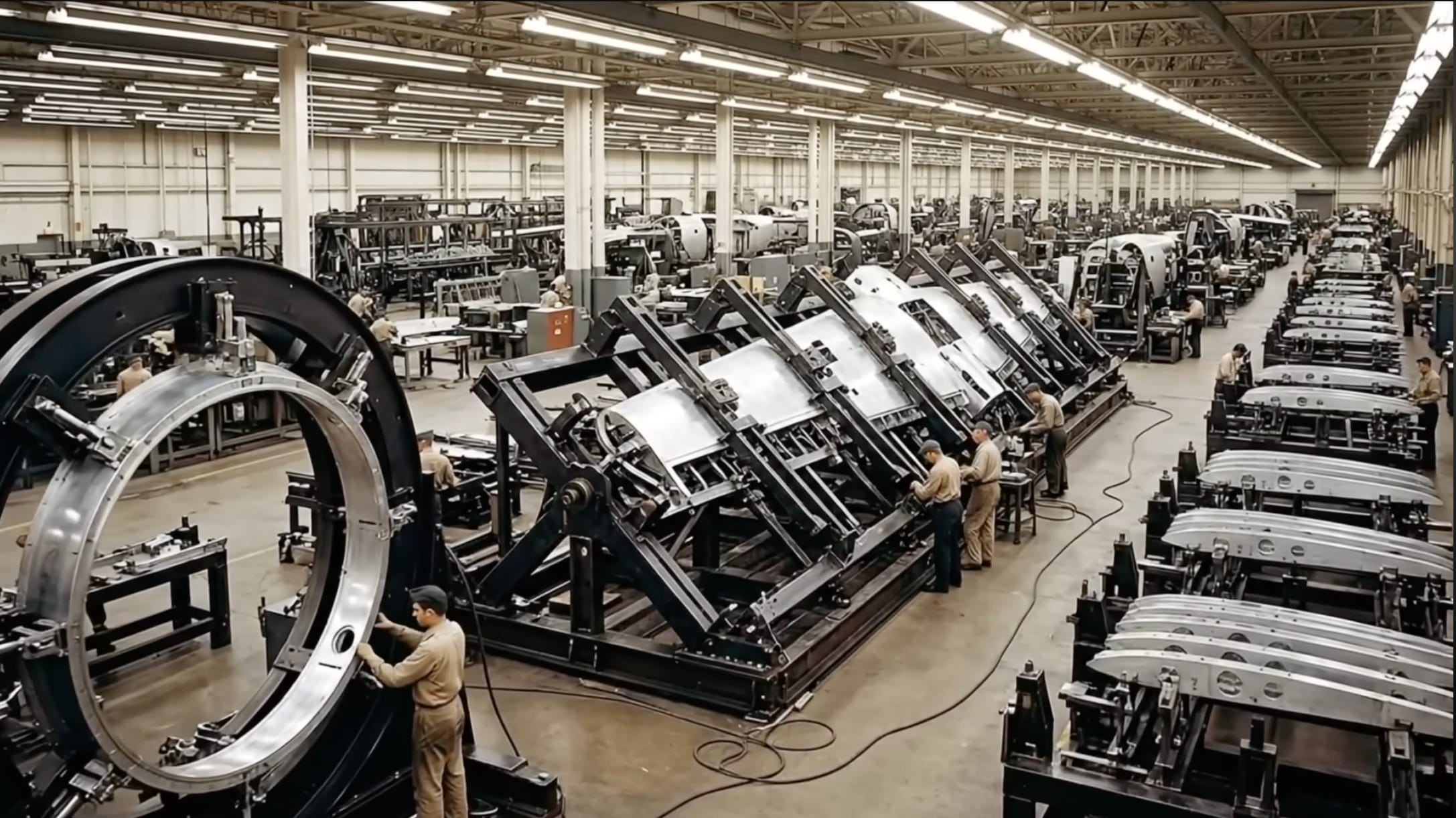
The memorable part is the line. The instructive part is everything around it. Demand certainty built that factory, not culture: Roosevelt asked for 50,000 aircraft, the government bought everything the line could produce, and Washington built a freeway (today’s I-94) to move the workers. An order book that certain is also the only known solvent for Gavin’s training trap, and Ed Tate’s contracts scale under exactly those conditions: Ford could train tens of thousands from scratch because no competitor could poach against demand the government had already bought. A third of those workers were women earning the same 85 cents an hour as the men, and they came because the pay was real, not because riveting got glamorous. Status followed the paycheck.
It took two years of public failure before the line worked (37 bombers in the first month, the whole state joking “Will It Run”), it required converting the largest industrial machine on earth (Detroit), and it shut down ten months after peak, the day the customer stopped buying. The greatest factory in American history was a demand artifact. The US of 2026 has no Detroit to convert and no FDR-scale customer except one, the Pentagon, which is why every durable company in this movement already has a federal anchor. And that’s not a scandal. That’s the playbook working as designed, just smaller.
So what does the floor actually look like in 2036? Fewer humans, paid properly, supervising fleets. Tesla is converting capacity toward Optimus with a reported 2026 target of 50,000-100,000 units against roughly 10,000 unique parts each, and around 70% of that supply chain is Chinese today: the reported $685M actuator order went to Sanhua, enough for about 180,000 robots, while US production plans fuel the rumor mill. Unitree already ships humanoids profitably at $4,290. I stand by my tier call from last issue: the US loses the cheap-volume robot race and shouldn’t enter it. But every robot deployed on a US floor, whoever built it, changes the labor math the same way: the job stops being “operate the machine” and becomes “own the cell.”
My third 2036 call, medium-high confidence: US manufacturing employment stays roughly flat even as output rises, but the median floor wage rises meaningfully, because the person left standing runs six machines and a robot fleet, and there’s no version of that job that pays badly. That’s the only honest path to Citizen Deux’s north-of-100k number: not status campaigns, revenue per worker high enough to pay it. Cabri doesn’t become a welder at $17 an hour. Either the cell pays her six figures to run it, or she keeps cleaning houses and she’s right to.
And the software those floors run? Jack Bookey (Nox Metals) posted the most useful number I’ve seen on it: assume 80% fidelity per human handoff and only 26% of a signal survives the round trip from company brain to factory floor and back. Nox’s answer is one schema spanning quote, ERP and edge stations on the floor. Software shaped exactly to their plant, in other words. And Caleb (OSH Cut) reminded me publicly last week that even “solved” parts aren’t solved: the on-demand space covers the easy stuff, the breadth of real capability barely at all.
Put those together and here’s my honest 2036 software read. The system of record doesn’t go away; every plant still needs one, and consolidation means fewer, deeper vendors. What changes is where the value sits. The fight moves up a layer, to the intelligence that watches the floor and closes Bookey’s fidelity gap, and that layer gets built two ways: in-house by the operator class that can staff it (Nox, OSH Cut, SCS, and many others now), and as products for the quarter-million US manufacturers that never will.
The ERPs that open themselves up to that layer become more valuable, not less. The ones that bolt a chatbot onto 2015 architecture and call it intelligence get found out. Either way, the largest software prize in American manufacturing is still unclaimed as I write this.
The 2036 Picture
Pulling the threads into one sketch. Speculation, held loosely, ranked by confidence.
High. The steel gap doesn’t close (79.5 Mt vs China’s 1,005 Mt is not a ten-year fix) and chasing the aggregate isn’t the point; new mills and smelters rise only where the energy math closes, on-site generation, flexible load, datacenter co-location. Zane’s grid-asset idea stops being clever and becomes the default site plan. And training-with-strings returns: as wages climb toward the clearing price, Ed Tate’s scholarship-and-clawback contracts become standard hiring architecture in the trades.
Medium. The US keeps two or three genuine process-IP strongholds (reusable launch, frontier fabs, possibly biomanufacturing) and defends them with China’s own export-control playbook. Two fully separate space stacks, cadence advantage US, industrial base advantage China. Humanoids (or some sort of hybrid) everywhere on American floors with a BOM still 40-70% Chinese, unless robot builders spend the decade qualifying domestic suppliers: at 100k units and a $20k BOM, the non-China share is ~$600M a year of work looking for shops. The biggest open bet in the picture.
Low, the wildcard. Demographics. China’s curve is steeper: population shrinking three years running, fertility near 1.0, the 320-million gig number hiding how thin the formal pipeline is. America historically replenishes its workforce through immigration; China doesn’t. Whether the US keeps that advantage is a policy fight I won’t touch here. I don’t know how this resolves. Neither does anyone selling you certainty.
The shape holds either way: 2036 US manufacturing is smaller in headcount, higher in wage, radically more automated, clustered in defense- and energy-anchored islands of density, running software its owners control, paying licensing rent on some process knowledge and collecting it on the rest.
Not the 1944 photo. Not the 1970s employment chart. Smaller than the speeches promise, better paid than either.
So…
The window is the strategy.
Funding: assume exits into a post-tourist market and underwrite to revenue, not narrative; a federal anchor is a feature, not a stigma.
Building: boring revenue before 2029 or get that anchor, and treat the robot BOM as the largest supplier-qualification opening since automotive (actuators, gears, harmonic reducers, test and pack, currently shipping from a country your customer is being told to diversify away from).
Supplying: the co-location wave is where new-site engineering money goes next.
Hiring: forget the millions who aren't coming. Design cells for the six people who are, pay them like they run the place (they will), and put an Ed Tate contract behind the training.
I’m Watching This
Does the Long March-10B booster actually refly before the end of 2026? Cadence, not capability, is the tell on how far behind China’s reuse really is.
Do China’s frontier-model export controls get enacted, and with what scope? Drafting is a signal. Enactment makes AI decoupling official in both directions.
Does manufacturing construction find a floor above ~$150B annualized? That’s the line between “the buildout matured” and “the buildout was a sugar high.”
The buildout is real. The window is short. Those are not the same sentence.
Const
Can you elaborate or point me to more information on the concept of "own the cell," please?
"But every robot deployed on a US floor, whoever built it, changes the labor math the same way: the job stops being “operate the machine” and becomes 'own the cell.' ”
It is an incredible essay, solid gold. Thank you.
Is it possible to get a non-Twitter version of Zane's article?