
I’m Const. 12 years in US manufacturing. Ran a machine shop, built DigiFabster (quick quoting for job shops), worked with hundreds of manufacturers across 40+ countries. This newsletter chases one thing: the gap between the headline and the data. Someone’s always selling hopium. I find it.
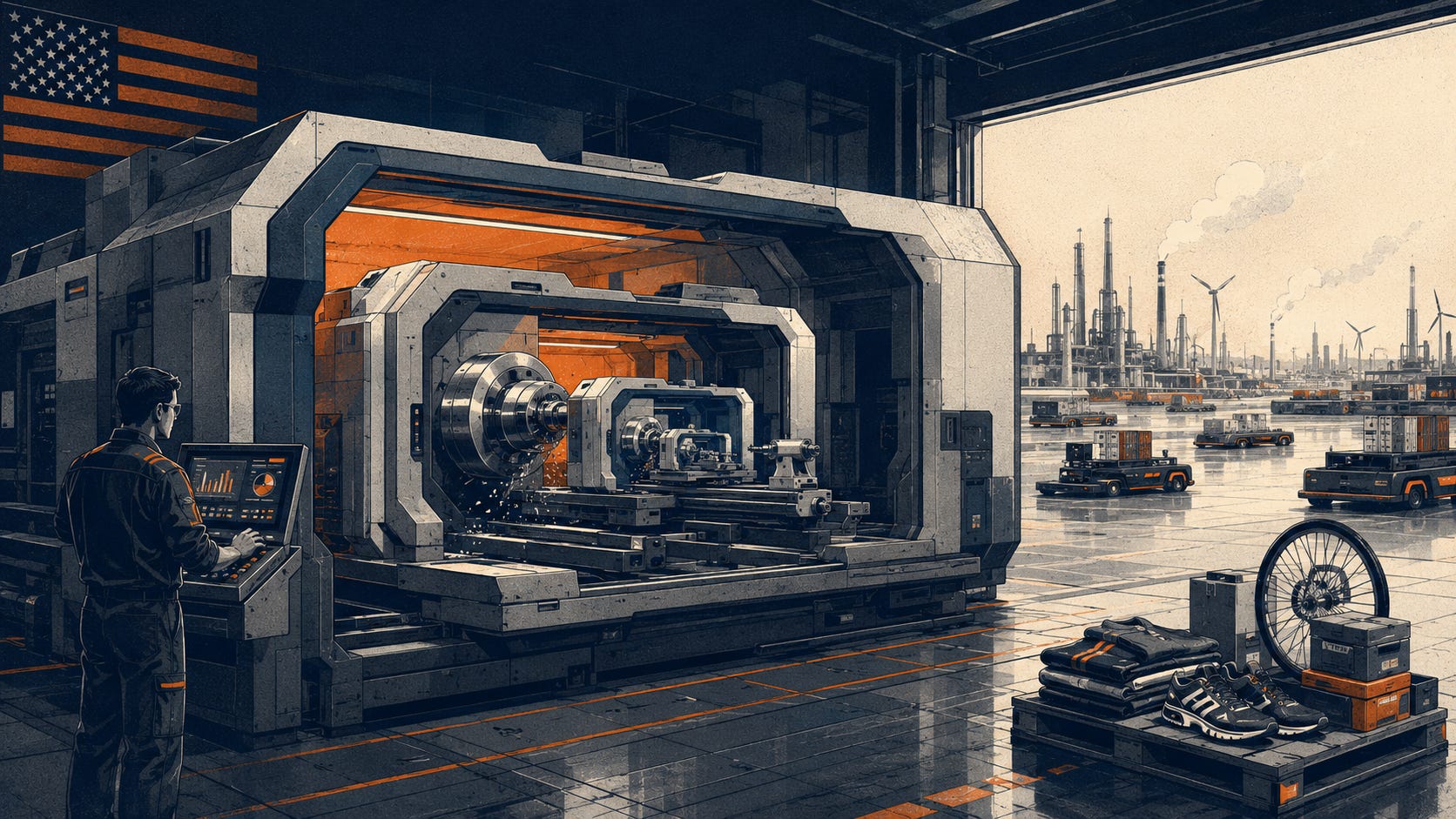
I made that call in May: China spent 30 years and 700 million people assembling that machine, and no subsidy rebuilds it on a ten-year horizon. Now I can put prices on it.
In 2002, Chinese factory labor cost 57 cents an hour. A hundred million people were moving from villages into factory cities. The whole world was opening its wallet. Those three conditions built Shenzhen’s supply density, and none of them exist anymore, anywhere. Not in Vietnam. Not in Mexico. Not even in China, which is why BYD’s newest plants are in Thailand, Brazil and Hungary.
So the low-wage path is closed. Not hard. Closed. No amount of subsidy reopens it. The conditions are gone.
But there is a second path, and three countries have been walking it this whole time. In 2012, the last year the BLS ran the comparison, German factory labor cost $45.79 an hour against America’s $35.67, with Switzerland at $57.79. They pay their factory workers more than America does, and they are still manufacturing powers. Japan pays about what we do and runs the deepest machine-tool bench on earth. How? None of them do consumer assembly. They make machine tools, precision components, instruments, factory automation. The stuff that makes the stuff. High knowledge, low labor share, number one in a thousand narrow markets that never make headlines. The Germans even have a name for those companies: hidden champions.
That is the whole choice. The low-wage path is gone, and the high-wage path is not a consolation prize. It is the layer with the margins, and it is the national version of what I keep saying about shops in Stop Counting Heads: fewer people, much more per person. America already produces $220k+ of value per manufacturing worker against China’s $40-50k. We are already the high-wage producer. The mistake is spending policy and capital trying to become the low-wage one again.
And America already owns pieces of this layer:
Applied Materials, Lam Research and KLA build the machines that make chips; most of the world’s fabs stop without them.
Lincoln Electric has made welding equipment in Euclid, Ohio for over a century and pays factory workers a profit-share bonus big enough to make national news: $33,029 a head for 2013, the last year they published the figure (hope it’s still going well).
Hypertherm cuts steel around the world and is owned by its employees.
And the next generation is already forming:
Machina Labs teaching robots to form sheet metal in Los Angeles.
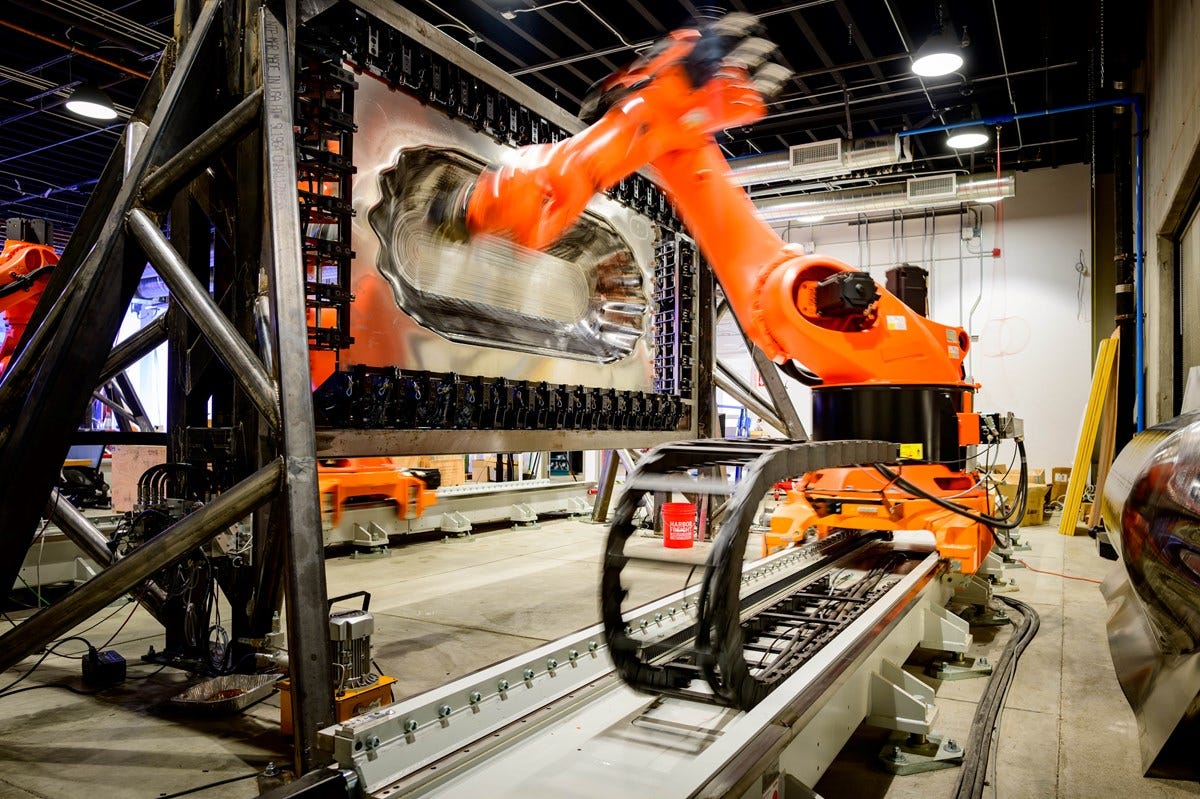
Divergent printing and robot-assembling structural parts, and raising $290 million in September 2025 at a $2.3 billion valuation to scale it for US defense.
Agility building robots in an Oregon factory built for building robots.
Three stories from this week show where the line runs.
America Is China’s Third-Biggest Customer
China’s exports to the US fell 20 percent last year, and total Chinese exports still grew 6.1 percent.
Where the goods go now: China’s total trade with ASEAN was $1.06 trillion, the EU $830 billion, the US $560 billion. America is third.
Some of that is relabeling, the Mexico story from May at national scale. But relabeling is the small part. Global Trade Alert sized the redirection at about $150 billion, landing in ASEAN, Africa, Latin America and the Gulf, with none of it showing up in the EU or Japan. Those are not transshipment hubs for the American shelf. They are customers.
The companies read the same way. Shein’s Europe business is now bigger than its US business, $14.8 billion against $10.1 billion, and the US side has sat flat at about $10 billion for three years. BYD sold 1.04 million cars overseas across 110 countries without selling one passenger car in America.
A tariff wall is a bet that reaching the American consumer is the thing worth paying for. That bet gets cheaper to lose every year.
The Wall Went Up Before the Supply
On Tuesday the FCC put foreign-made robots and power inverters on its covered list. The exemption path runs through the Buy American standard, and that standard has a schedule: domestic components have to clear 65% of component cost through 2028, then 75% from 2029. Assembly does not count.
Three weeks ago, in What Survives to 2036, I put humanoid robotics at 40 to 70 percent Chinese BOM. This week the FCC made that number a compliance problem.
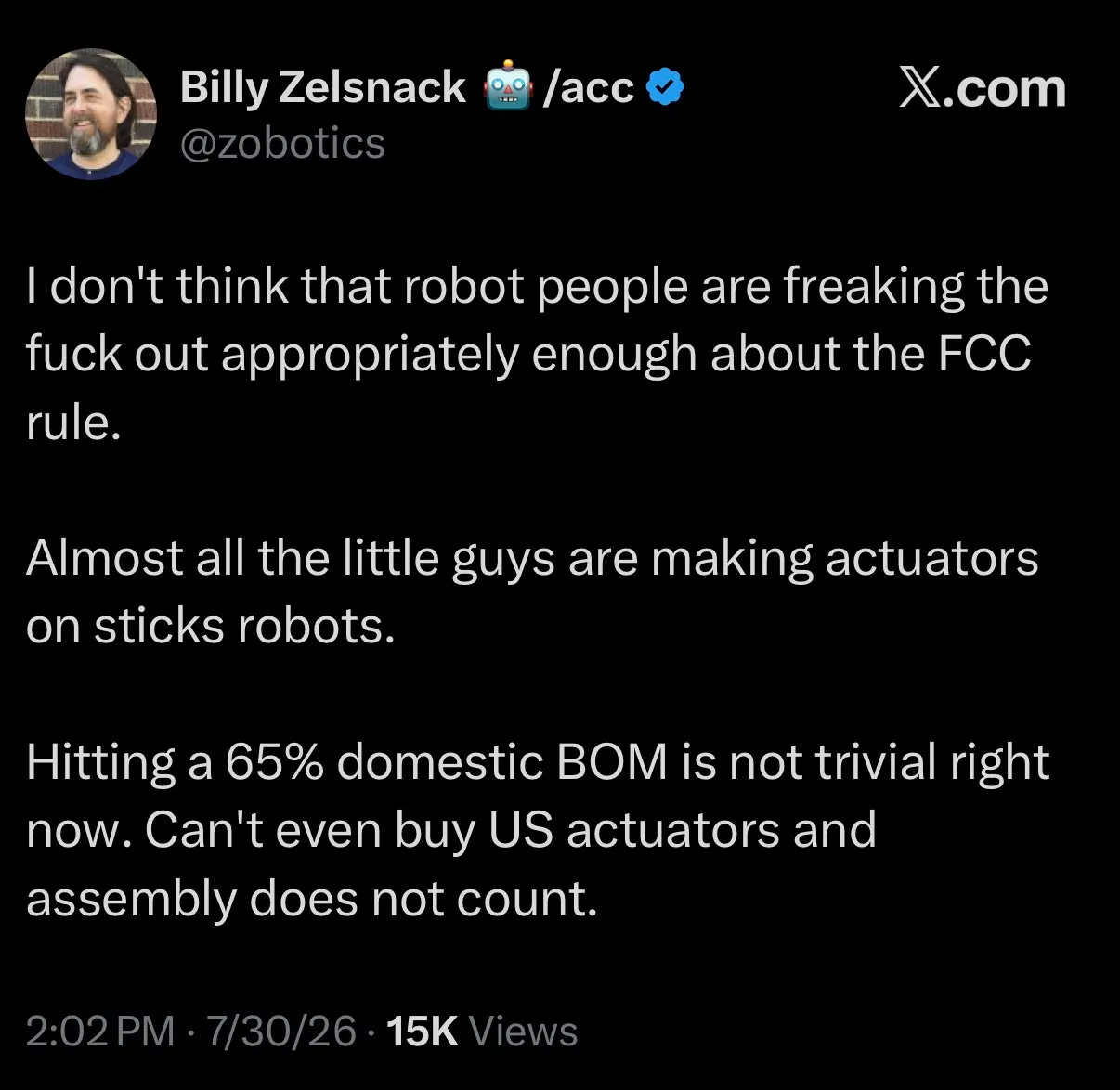
A robotics builder did the math in public: you cannot buy American actuators at scale. The one part every robot needs. Thirteen hours into his thread, a small shop in Upstate New York replied that they build precision rotary and linear actuators for humanoid robots, in their own plant.
Hold both facts. There is a legal requirement, and there is no supply. Whoever builds the supply has customers waiting by law, and the deadline is 2029.
The timing matters more than the rule. Automation is the only way a country with American living costs competes on labor, and the US just restricted the imports its own automation runs on. Robots for robots come first. And the honest benchmark for a robot here was never “beat a Chinese worker.” It is “beat landed cost plus tariff plus six weeks of lead time.” That is a lower bar. In some categories it is beatable now.
Notice what an actuator is, by the way. It is not a consumer product. It is the stuff that makes the stuff.
The Machinist Isn’t Underpaid
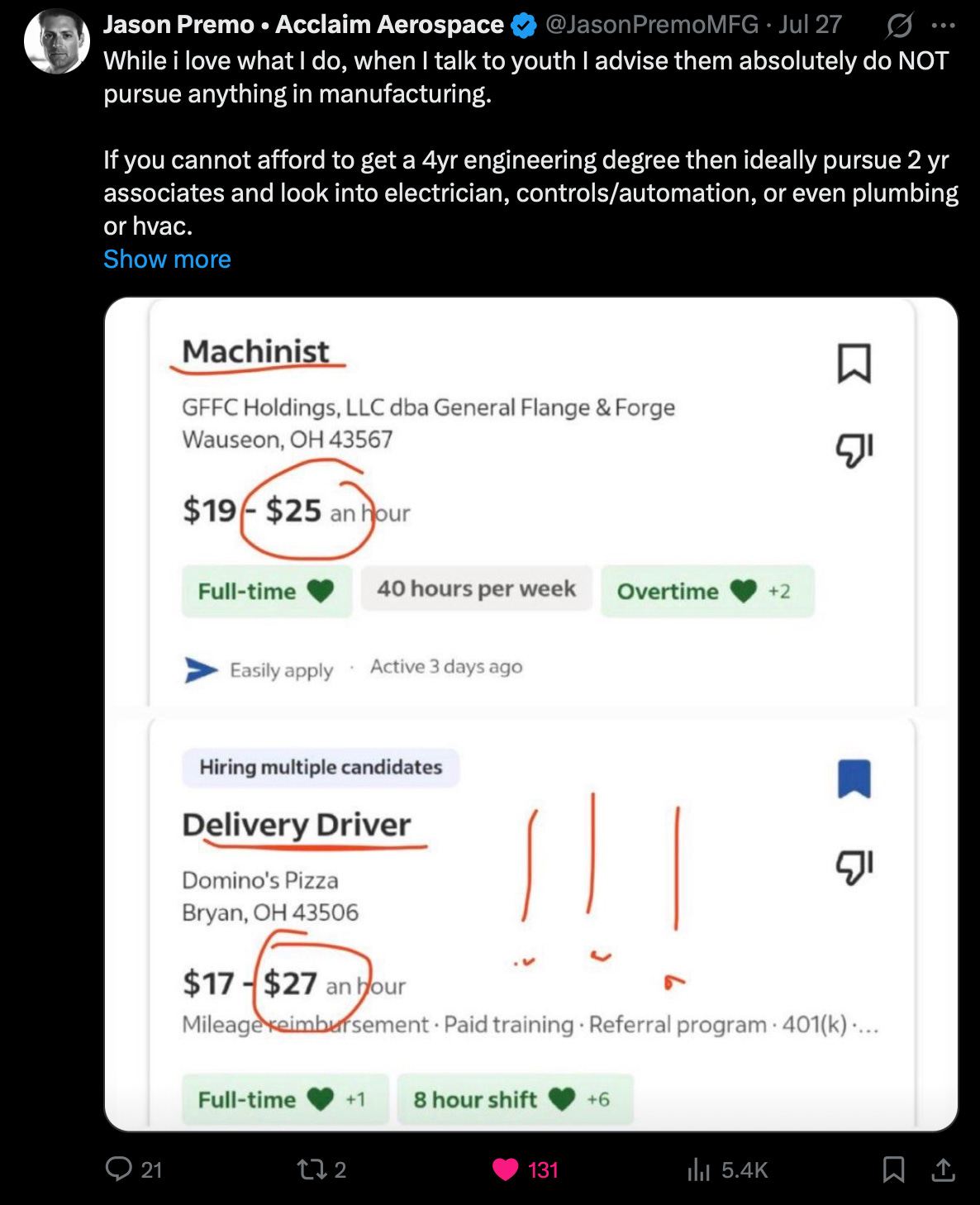
A shop owner telling kids to stay out of the trade he runs. Downthread he says why:
“the wages are still stuck in the 1990’s.”
The two ads are not a clean comparison, the Domino’s number folds in tips and mileage against the driver’s own car. The national medians are cleaner and they say the same thing. Machinist $56,150, plumber $62,970, same high school diploma to start, and machining is the only one of the two projected to shrink. Meanwhile 462,000 manufacturing jobs sit unfilled.
Everyone reads this as “manufacturing pays too little.” I read it the other way.
The machinist is not underpaid by world standards. He is priced out by his own economy.
Housing, healthcare and school set the cost of his life, and the services economy around him sets those prices. An expensive life prices labor out of factories. A tariff adding 10 to 12.5 percent to a bike, depending on where it comes from, is real money, and it is small next to rent.
The German machinist costs even more than ours and stays busy, because he works in the layer where labor is a small share of the product and the product is number one in its niche. That is a positioning problem, not a wage problem. Fixing the machinist’s rent is government work, not startup work. Fixing what he works on is ours: fewer people, much more per person, in products the world has to buy.
A Wall With No Export Test
One warning before my Builder Read. Japan's phone industry grew up inside a protected home market and never won outside it. Korea protected its industry too, with one difference: survival was conditional on selling abroad. POSCO and Samsung had to win outside the wall to keep their place inside it.
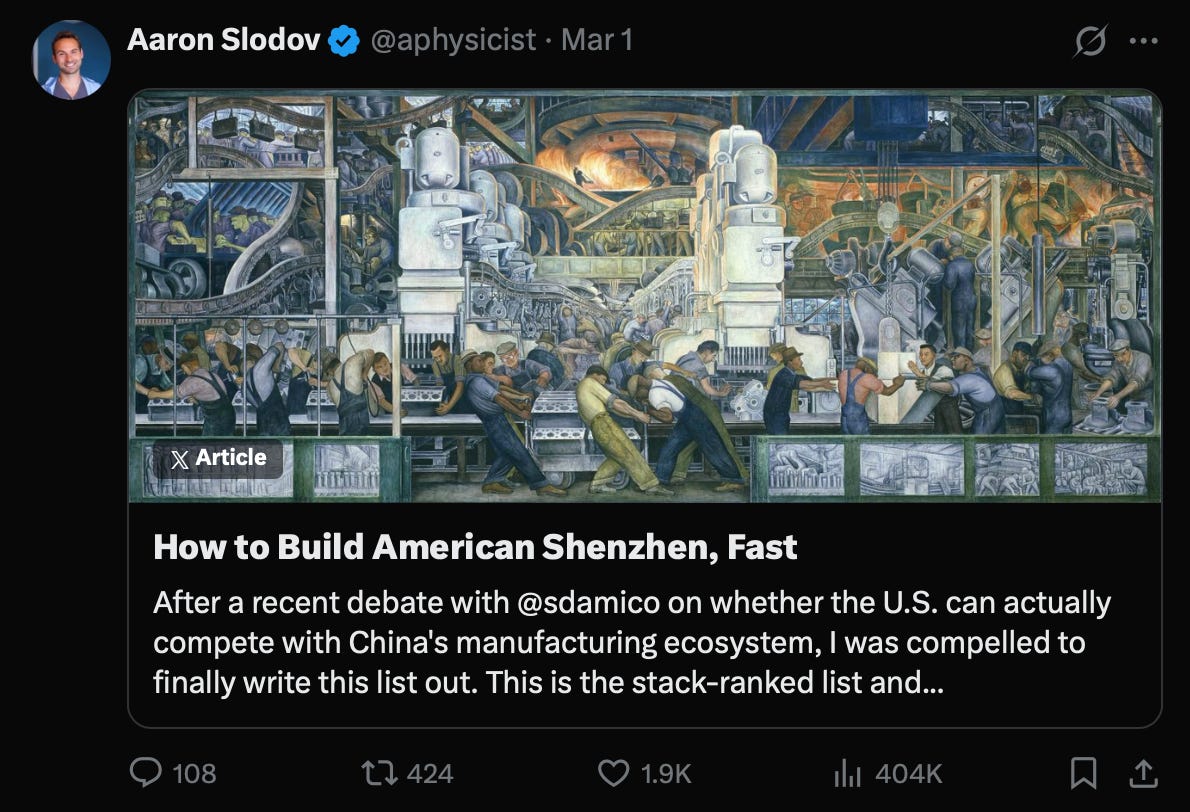
The sharpest blueprint for rebuilding here makes the same miss. Aaron Slodov’s “How to Build American Shenzhen, Fast” is the best case anyone has written for rebuilding the full stack, and I agree with most of it (his factories run on software and small teams, his list runs materials, electronics, machining, actuators). But read it asking one question: who buys? The answer is American startups and the Pentagon. The word export appears four times in the whole essay, every one about Chinese export controls. His stated endgame is that Chinese component dependency “becomes moot.” That is import substitution, not competitiveness.
And his map of 68 reindustrialization companies has exactly one entry under machine tools, a mobile machine shop in a shipping container. He sees the gap. He writes that America "barely makes the machines that its factories run on," and then scores that category a 3 out of 5 on venture return and a 3 on dual-use, in the same entry where he says the dual-use case is inherent because every factory needs machine tools. It lands twelfth of twelve. The dependency is not in dispute but the scoring axis is.
The American wall has no such condition. Protection, no performance test. A base that only ever sells to mandates and startups will be excellent inside the wall and helpless outside it. A wall without an export test breeds dependents. Korea’s bred Samsung.
Germany’s hidden champions never needed a wall at all. Their test was the world market from day one, and that is why they can pay $45 an hour.
The wall needs a door.
Builder Read
The opportunity is a filter, not a field. A gap is worth filling in America only when at least one is true:
a mandate guarantees the demand (the 65% domestic content rule, the specialty metals clause);
physics favors proximity (heavy, bulky, custom, fast-turn, what OSHCut‘s Caleb Chamberlain told me: “we beat them on speed, we tie them on heavy”);
or labor is a small share of cost (a fab is mostly machines, which is why TSMC keeps doubling Arizona, now $265 billion committed).
Everything outside the filter stays imported, and should. Aim at the layer that passes the filter everywhere: the stuff that makes the stuff. The covered list is a parts catalog of things America now has to learn to build, with a date attached. What Survives to 2036 said pick narrow and go deep. This is the list to pick from.
I’m watching this
Whether that actuator shop in Upstate New York ships in volume.
And whether Chinese machine tools keep moving upmarket, because five domestic immersion scanners targeted for 2026 and 20 for 2027, against ASML’s roughly 130 a year, is a ratio today and a trajectory tomorrow.
The high-wage layer is reachable, but it is not reserved.
Const
(I’m RW )There’s no way wages can keep up with market inflation of housing. There’s no market solution to housing prices or rents. The recent measures taken (combined with a fear of the masses and people especially the young) have lowered the line /line go down but not enough. Now as the government got involved with housing and the markets via FANNIE/FREDDIE, Bailouts, TARP and QE et al THEN the government can get involved in getting the costs down. The virginity and virtue of Maiden Market has long been gone, there’s no Market Maidenhood to defend. So GOVERNMENT having “Known” maiden market can now make Her an Honest Woman that looks after the Kids … instead of her running around all over town and indeed the world. Oh Fair Lady, thou shall be a better mother, let them eat cake doth not suffice.
This has just been done with PHARMA and other areas of Healthcare, so it’s *consistent* with policy including the beneficial pro people policies of the administration.
Why does a typical UL or similarly certified actuated valve (say 2") cost on the order of $1000?
While I can believe that the cost of living plays a role, someone is taking a massive profit. If I am to guess, it would be UL---a product of the insurance industry, the latter of which current massive font of fraud.
A big part of the existing economy does need to die in some form or another, e.g. society would do well to have the whole (project) manager ecosystem decimated. Regulators have also gutted engineering as a serious discipline by refusing in-house engineering and demanding that everything go through a consulting engineer, again likely at the behest of the insurance crowd
Also, Festina Lente --- too much running around (at the insistence of project managers and the like) like decapitated chickens, not enough time doing industrial small scale experiments.