
I’m Const. 12 years in US manufacturing. Ran a machine shop, built DigiFabster (quick quoting for job shops), worked with hundreds of manufacturers across 40+ countries. This newsletter chases one thing: the gap between the headline and the data. Someone’s always selling hopium. I find it.
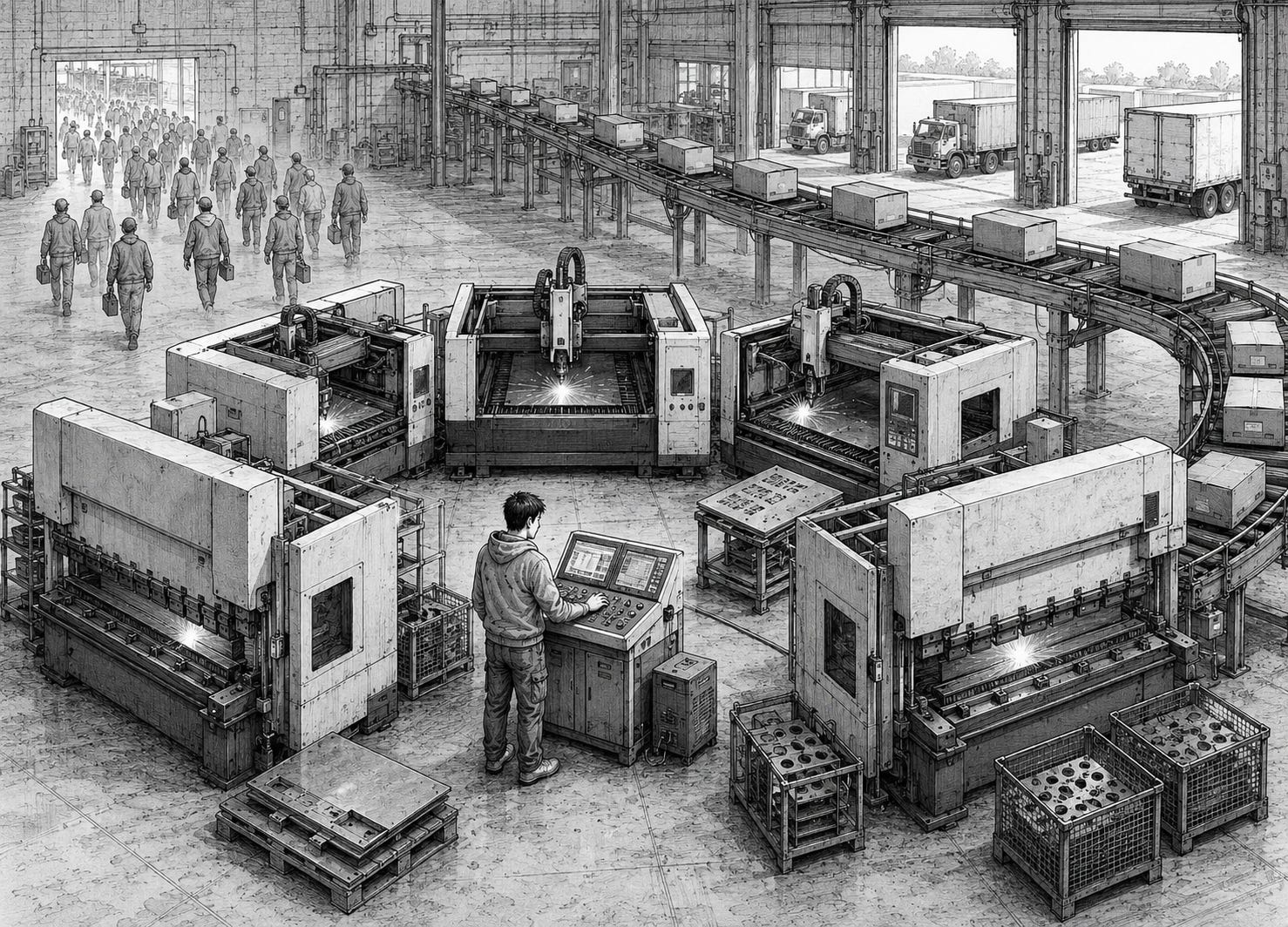
Last week’s 2036 issue argued the wage never cleared the market. This week my good friend Mike Payne named the metric that proves it, a unicorn showed the fix, and a 20-year robotics retrospective supplied the clock. I’ve come to believe this one number decides who survives the window, so I’m giving it the whole issue: what a US factory has to look like to still be here after the money leaves.
The Number That Matters More Than Headcount
Mike runs Hill Manufacturing, hosts Buy the Numbers (a podcast about the actual financials of running a shop), and buys machine shops the way I collect signals. After the 2036 issue he wrote something I’ve been chewing on all week:
“We keep telling ourselves it’s a labor shortage. Kids don’t want to work. Nobody respects the trades. Honestly, it’s a lazy excuse... Here’s the number that matters more than headcount: revenue per employee.”
And the test that goes with it:
“Can you pay a welder six figures and still make money on the job. If the answer’s no, you don’t have a hiring problem. You have a pricing problem.”
Run the math and his point stops being an opinion. A $100k welder costs roughly $130k fully loaded (payroll tax, insurance, benefits; estimate, not gospel). Direct labor in machining and fab typically runs 25 to 35% of revenue. So paying six figures comfortably requires somewhere around $400,000 to $520,000 of revenue per employee.
Now the industry’s actual number. Mike, who buys shops and looks at their books for sport, described the average American precision machine shop on his own show:
Roughly 18,000 to 19,000* job shops in the country, and the average one runs “about 10 machines, 12 employees, 2 million in sales.”
* Personally, I’m a bit more skeptical about the actual number of job shops in the US. My best guess is it’s closer to 10,000.
Twelve people, $2 million. That’s $167,000 of revenue per employee.
There’s the whole labor crisis in two numbers. The six-figure welder needs a $450k-per-person business. The average shop is a $167k-per-person business. The wage can’t clear because the revenue per person can’t carry it, and no job fair, no trade-school campaign, no culture war about kids these days changes that equation by a dollar. To me, the house cleaner from the 2036 comments (earning $20 to 30 an hour, offered $13 to 17 in every trade she priced) read manufacturing’s P&L more honestly than most of its owners do.
And Mike’s diagnosis of WHY the average shop is stuck at $167k:
“The owner has become the bottleneck... they do the sales, they do the quoting, they’re scheduling the floor, making sure invoices went out.”
I spent 12 years watching exactly this person: the owner quoting at midnight after running the floor all day. I built a whole company for them. The shop floor was never the problem.
The Unicorn Ran Exactly This Play
Which brings us to SendCutSend (again, I know). The raise itself is a month old (mid-May: $110 million at a $1.01 billion valuation from Sequoia, Paradigm, and Stripe’s Collison brothers), but The Fabricator’s deep dive published this week finally put real numbers under it, and to me the numbers are the story. A sheet metal shop from Reno, valued like a software company, because in the way that matters it is one.
The numbers underneath: revenue “well over $150 million,” about 450 employees across four states. That’s $333,000 per employee and climbing, double the industry average, on the road to the six-figure-wage threshold. And here’s the detail I think many will miss while staring at the valuation: SendCutSend got there with a largely manual floor. Manual denesting. Manual bending. Operators with suction lifts. No lights-out automation anywhere.
What they automated instead was the front office. Upload a file, get an instant price, click accept, and the order nests itself and queues to a laser in minutes. One order was nested and on the laser minutes after the customer clicked accept, and boxed 27 minutes later. Their lasers run at 88% beam-on time, a number most shops don’t hit in their dreams, not because the machines are magic but because no order ever waits on a human quote, a human nest, or a human schedule. The late industry consultant Dick Kallage said it decades ago:
“You’re not in the metal fabrication business. You’re in the information processing and changeover business.”
SendCutSend is what a shop looks like when someone finally believes him.
The labor model completes the picture. They hire from “the donut shop, Dollar Tree, and Walmart” and train in-house, from day one, by design. High revenue per employee doesn’t require finding skilled workers who don’t exist. It requires a system productive enough to justify manufacturing the skill yourself.
Founder Jim Belosic’s own account of the raise is the part I reread more than once. He funded the company on cash flow for eight years, stayed profitable, and then:
“We held out until the ‘reindustrialize’ vibe shifted and we found partners who actually understand that hardware is hard.”
An operator built boring revenue first, watched the capital window open, and priced it on his terms: sold 10%, one raise,
“I don't want to be on a treadmill, out there raising funds every 18 months.”
That’s the sequence. Revenue per employee first, venture money second, and only for capacity, not payroll.
Even his competitor endorses the logic. Caleb Chamberlain, who runs OSH Cut and has every incentive to dunk, wrote instead that the valuation reflects a real bet: web-first players still account for less than a thousandth of US manufacturing output, McKinsey counts 71,000 manufacturing owners exiting by 2035 with over a quarter unsure of succession, and somebody’s systems will absorb that demand. Mike Payne sees the same wave from the buyer’s chair:
“I show up, talk to some shop owner and they haven’t prepped, they haven’t done anything. They’re just ready to be done today.”
Seventy-one thousand $167k-per-person businesses are heading for the exit. And the question is what replaces them.
The Ten-Year Clock
Here’s where the impatient money should pay attention. Max Lobovsky, who co-founded Formlabs, posted a 20-year robotics retrospective this week that every reindustrialization deck should be forced to include. Collaborative robot arms: 40 years in, roughly 8% compound annual growth. Autonomous vehicles: the single biggest success of the cohort, and it took the full 20 years and around $100 billion to reach limited commercialization. Humanoids: two decades after Robonaut, still mostly “incredible demos” and entertainment. His conclusion:
“Impressive demos usually precede meaningful commercialization by a decade or more. If you want to build something that scales in the next decade, look for an idea that was demonstrated 10+ years ago.”
Apply that filter to this issue and it clicks into place, because web-first manufacturing is even older than most people remember. Quickparts was selling instant quotes for custom parts back in 1999 (3D Systems bought it in 2011), and Protolabs was quoting molded parts with software in the early 2000s when it was still called Protomold. 247TailorSteel put the full model on a European shop floor in 2007 (today: 70,000 parts a day).
SendCutSend and OSH Cut proved the US sheet metal version in 2018. So the unicorn is a quarter-century-old idea finishing its apprenticeship, which by Lobovsky’s rule makes it exactly the thing that scales this decade.
I lived a piece of this timeline myself: I spent a decade pitching instant quoting to shop owners and hearing “our parts are too complex for that.” The tech was never early. The industry was late. The robots that will eventually automate these floors run on the same clock, which is why the smart operators automated the inbox first and are only now, with the capital and the order book, buying the robotic brakes.
Now… the uncomfortable half of the lesson, because the same clock convicts the opposite strategy. Venture money arriving this fast into hardware tempts founders into the oldest trap in the window: hire ahead of revenue. Headcount is the most photographable form of traction and the most expensive form of payroll, and when the window shuts (my 2036 issue put that around 2028-2030), a company built to 200 people on raised money has to lay its way back to whatever its revenue per employee actually supports. In manufacturing, where trust is the asset and communities are small, that’s often fatal. The companies that survive the window are the ones that treat it the way Belosic did: a chance to buy machines and capacity, never a chance to buy headcount that revenue hasn’t earned yet.
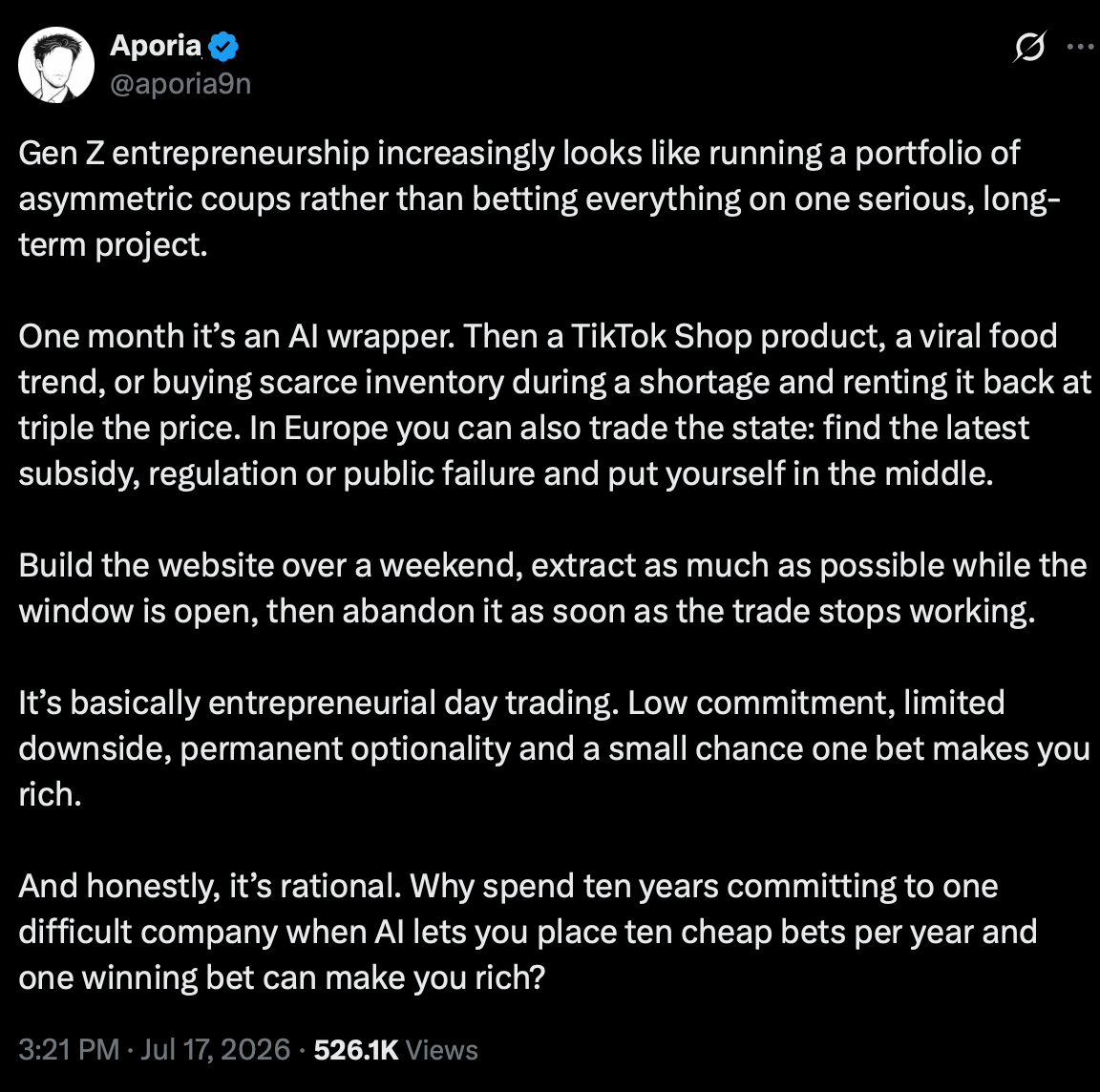
And the clock explains one more thing I keep seeing. A thread going around this week on X described Gen Z entrepreneurship as "running a portfolio of asymmetric coups": an AI wrapper one month, a TikTok Shop product the next, "extract as much as possible while the window is open, then abandon it as soon as the trade stops working."His best line:
"The old founder wanted to build one company that would outlive him. The new one wants enough wins that he never has to depend on one company at all."
I won't pretend that's stupid. It's rational, and that's the point. Run it against Lobovsky's clock and manufacturing becomes the one arena the day traders will always self-select out of, because nothing here pays inside a rotation cycle. Commitment looking irrational everywhere else is exactly what makes it the edge here. The crowded trade is optionality. The empty trade is ten years.
Zoom all the way out and this is also the only honest answer to the China question.
The US runs roughly $2.9 trillion of manufacturing value added on about 12.9 million workers, call it $220,000-plus per worker. China runs $4.9 trillion on a manufacturing workforce so large it’s genuinely hard to count, putting its number somewhere around $40,000 to $50,000 per worker. America is already four to five times more productive per person, and it cannot win, will never win, a headcount contest against a country with four times its industrial workforce and five-year plans against our four-year attention spans.
I’ve walked Shenzhen’s shop floors (30 to 90 person operations, three shifts, running 24/7), and I can tell you there is no American Shenzhen coming, not overnight and not this decade. The one that eventually emerges won’t look like Shenzhen at all. It will look like SendCutSend’s Reno: smaller headcount, higher automation, $400k-plus per person, wages that finally clear. Fewer people, much more per person. I believe that’s the only version of reindustrialization that can actually work, and I’d rather build for it than mourn the 1979 photo.
So…
For the wallet reading this. Funding: underwrite revenue-per-employee trajectory, not headcount growth; in this sector, hiring ahead of revenue is a liability wearing a traction costume.
Building: track revenue per employee monthly and margin per FTE if your mix is wide (Mike’s refinement); price so a six-figure wage works or fire the customer that forbids it; automate the inbox before the floor, because the unicorn’s first $150 million came from a manual floor and an automated front office.
Buying: 71,000 owners are exiting $167k-per-person businesses that trade at 2 to 4x EBITDA, and the playbook to double their RPE is now public. That’s the least glamorous, highest-certainty trade of the entire buildout.
I’m Watching This
Musk quietly bought APR Energy: ~$1B, revealed only by an SEC filing, for 1+ gigawatt of truck-mounted turbines that skip the five-year grid queue. Every AI lab can buy the same chips; one now owns power that ships by truck. Watching for the first follower, because one buyer is an anecdote and two is the co-location thesis going mainstream.
OSH Cut is opening a second factory near Cincinnati. The web-first expansion continuing under the unicorn headline, without the venture money.
Xometry Q1 revenue up 36% year over year. The marketplace end of the same model, growing at public-market scale.
The buildout doesn’t need more people. It needs more per person.
Const
I keep telling my people and those who will listen, first MMT is the only true way to look at economics. Anything other than that and we are spinning our wheels and we will only have the so called UniCorns who can pay six figures. On that note Keynes is quoted as saying back in the 1930,s that by the time his grandchildren reached the year 2000 they would only be working 15 hours a week, and spending more time on recreation. He was correct on the New Deal, like it or not convservatives. The only thing from proving him right on the 15 hours is a Mind Shift in how we do work. You layout one portion of that in manufacturing, which I agree with. But you can't make people want to work and do a stellar job. But is that important in an automated factory. Yes, even running robots, which we do still requires a talented person with a good work ethic. That is unchangable. Unfortunately a bit of what I hear from you in your postion is the same thing we heard during the Internet Bubble. All the young go getters, were telling the tried and true investors "we live in a new world" to which they old guys said, you can't argue against the math! Well we know how that works. It wil be be a mind shift of monumental degrees to reach where these Unicorns have gotten. There are alwasy these guys in truth. It takes years to get new "status Quo" which is what you are championing here. I am with you but as a person who has lived a bit longer and studied history as part of my eduation, managing expetations and the wild card, PEOPLE with free minds and all of us diseased by Pragnostic Myopia it will be a never endign battle, but one worth the struggle.
Let's hear it for efficiency and the bottom line.
But I think that leaves a lot behind. There's more to life than tech.
I'm not judging, at least not presuming that my judgment trumps all others.
Still, in the systems discussed here, the operator is just another part of the machinery.
I don't know haw many people who read this have seen the silent movie Metropolis. As a silent movie, it's archaic. As a commentary on our time, it's highly relevant.