
I’m Const. 12 years in US manufacturing. Ran a machine shop, built DigiFabster (quick quoting for job shops), worked with hundreds of manufacturers across 40+ countries. This newsletter chases one thing: the gap between the headline and the data. Someone’s always selling hopium. I find it.
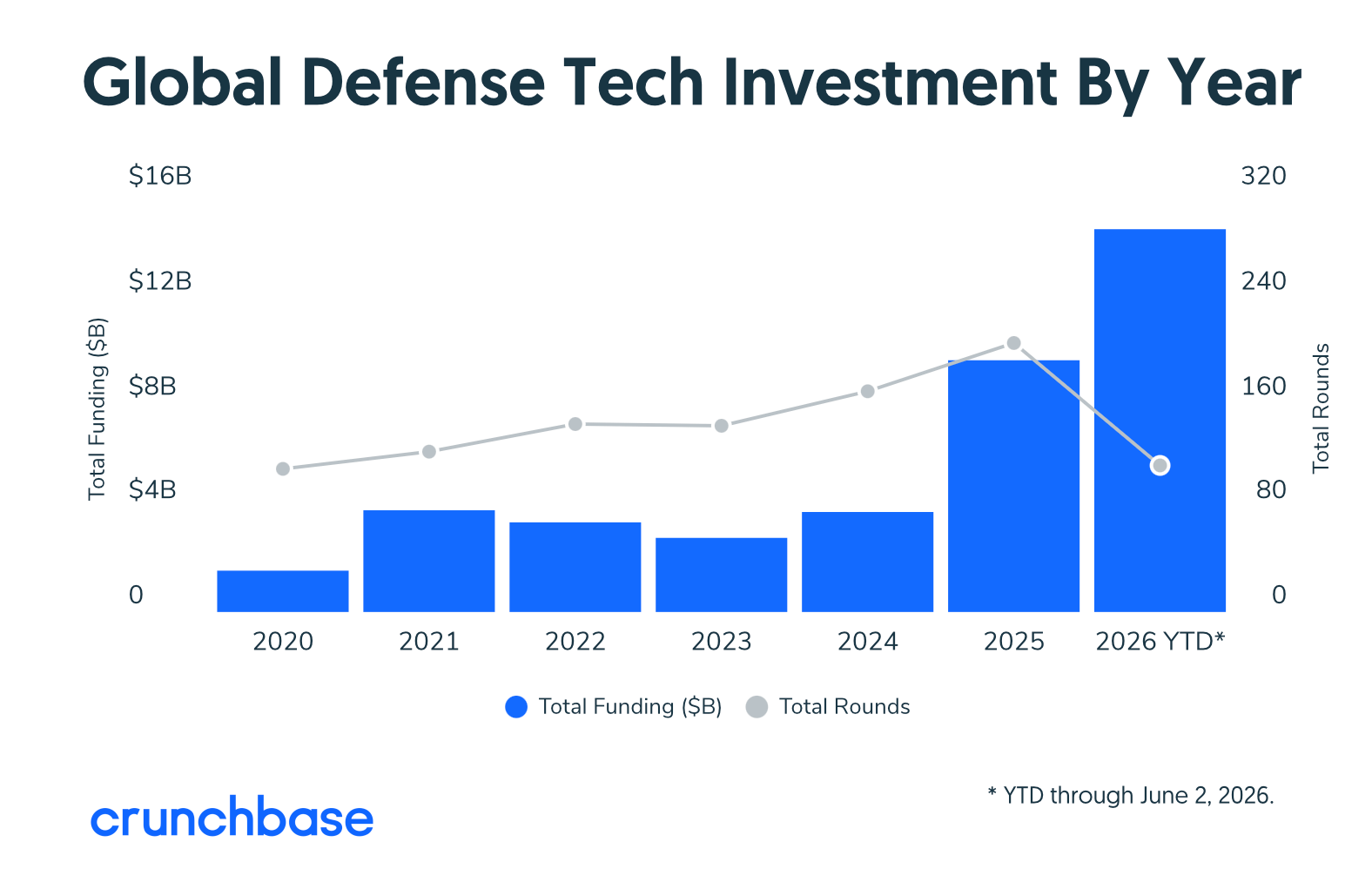
The reindustrialization money is real and it's loud. But almost all of it lands in one place. Defense startups pulled $14.6B in the first five months of 2026, already past all of last year. There are two more layers underneath that one, and I think they decide who actually gets built. Worth walking down all three.
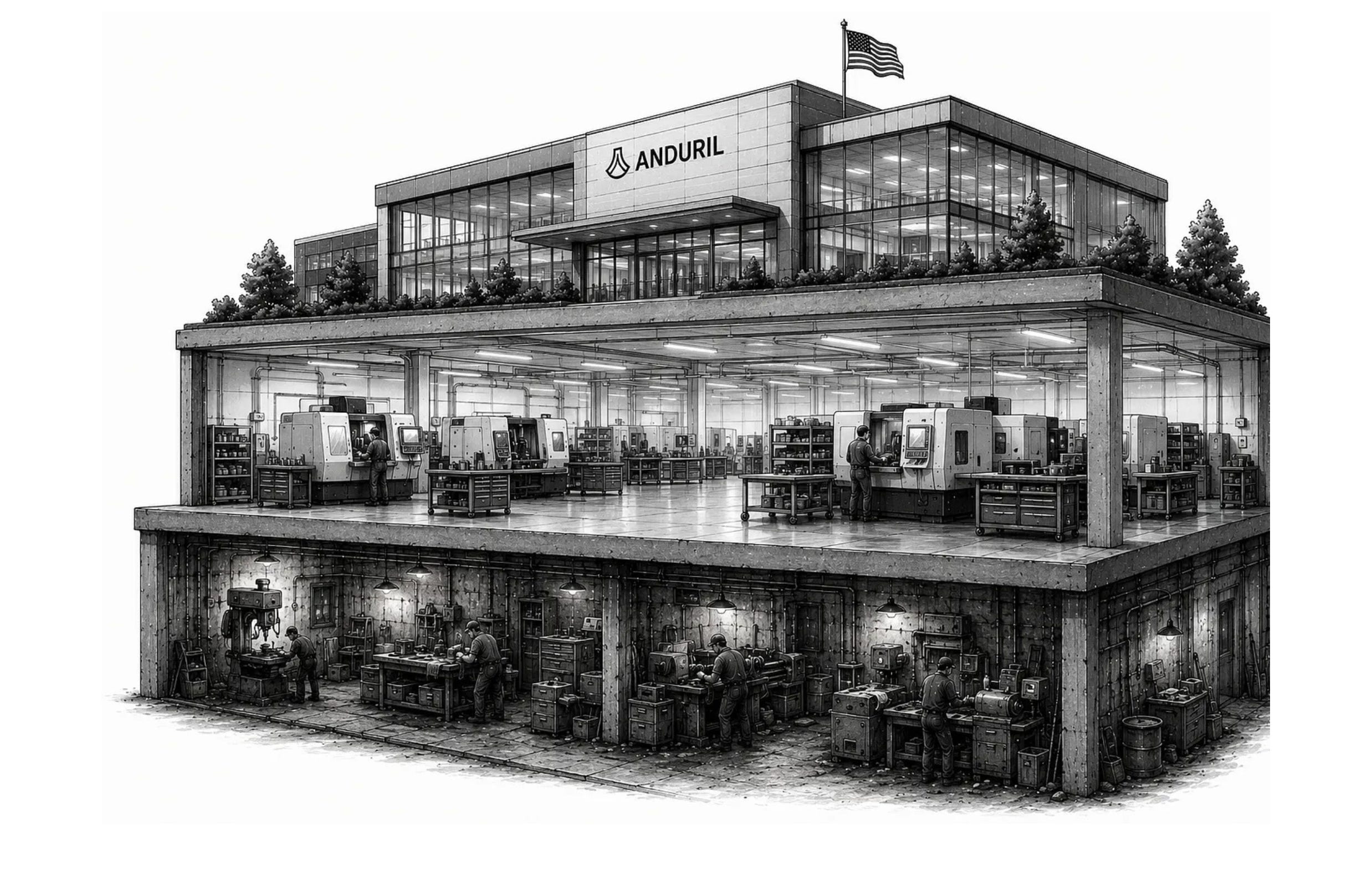
The Top Layer Gets The Checks
Primes, neoprimes, and YC startups are raising like the window shuts tomorrow. Anduril took $5B at a $61B valuation in May. Mach Industries raised $300M. Hadrian hit a $1.6B valuation in January with T. Rowe Price, Founders Fund, and a16z in the round, six months after raising $260M. People in the space will tell you Hadrian and a few others basically have unlimited money right now, and they’re not far off.
Then the old guard moves. On June 16 GM and Lockheed signed an MOU to explore building missile and interceptor parts together. No specific parts named yet (it’s an MOU, not a contract). The last time Detroit retooled for weapons was 1942, when GM turned out tanks and aircraft engines and Ford ran B-24s off Willow Run. That’s the reference point they’re reaching for.
GM can machine the parts. The slow part is getting defense-qualified: ITAR, AS9100, DFARS, a first article floated six months while the government signs off. Allison Giddens, who runs a 30-person precision shop, lived exactly that. Her line from last issue stuck with me:
"Everyone preaches 'resilience' from a conference stage, coming out of the mouths of people who have never had to make payroll."
As primes scale, they spin off thousands of operational problems they can’t solve inside their own walls. Solving those is the opening, becoming the supplier they can’t replace. The capital is watching GM, but I’m convinced the real work is one tier below it.
One Tier Down, The Shops That Climbed
A tier under the primes sit the shops that actually cut metal, and a few of them are winning big. SendCutSend bootstrapped to $200M in revenue, then took $110M from Sequoia and the Collison brothers in May at a $1B valuation, and committed $1B over five years to US capacity. OSH Cut and Fabworks climbed the same road: software first, fast quotes, the small customers nobody else wanted (but now everybody wants them ofc). They built the speed themselves over 5 to 10 years, and speed is the product. Caleb Chamberlain of OSH Cut said it best:
“We’ll never beat China on price. We beat them on speed, we tie them on heavy.”
None of them are defense suppliers though, to be clear. They're not ITAR or CMMC compliant, and the closest they get is prototyping for robotics and space startups. Their customer is the commercial buildout, and that's the side I'd rather build on.
The other way up is outside money. Operators with PE or private capital behind them buy good Tier 1 shops and rebuild them into the fastest suppliers they can hand to Boeing and Lockheed. Bootstrap for a decade on the commercial side, or get bought and re-tooled into a prime supplier. For a legacy shop, I think that second road is the best outcome on the table: capital behind you, and a spot in the supply chain the prime can't reorder around.
The Bottom Layer Can’t Get Funded
However, most shops are on neither road, and that’s the part I’m concerned about. Legacy Tier 1, 2, and 3, running on tribal knowledge, paper travelers, and a quote that lives in one guy’s head. They buy AI tools and get nothing usable back, because the data underneath is a mess. Ben Sheats at The Fabricator said it plainly:
“In the absence of your specific data, a language model will pattern-match against everything it’s ever read about manufacturing in general, and hand you averages dressed up as insights.”
You have to make the shop readable first. Most can’t, and no fund is paying them to try.
So their capital is an SBA loan. Zach Glabman calls it synthetic relationship banking. The shop is illegible to a bank, and he nails why:
"the best-run shop in the county and the worst one might get the same terms, because on paper they look nearly the same."
A federal guarantee stands in for the local banker who used to know them both. The newest tool is MARC, a manufacturing loan line from September 2025, built for the trap that kills these shops: a record order that pays NET 120 while the material bill lands next week (we covered that squeeze last issue). I believe the most boring agency in Washington is doing more for reindustrialization right now than DARPA or the Pentagon. And this is the layer everything above depends on, running on the least money of all.
I’m Watching This
The FATP gap. em mhouris put it flat on June 20: ten years ago you couldn’t get a part made, today there are ten options for CNC, and assembly never got that treatment. Nobody has built the on-demand version of final assembly, test, and pack. When Tim Cook said China had skilled labor, not cheap labor, this is the part he meant. If the middle layer grows somewhere next, my bet is here.
Midjourney Medical. On June 18 an AI image company announced a full-body ultrasound scanner. The chip is licensed from Butterfly Network and made by TSMC in Taiwan, and no US manufacturer has been named. American cap table, Taiwanese bill of materials, the same story I wrote last time. I want to know where they actually build it.
June PMI, out July 1. ISM manufacturing printed 54 in May, fifth straight month of growth, with tariff and input-cost noise sitting underneath. I’m watching whether new orders hold above 50 or the streak finally breaks.
One Last Thing
So, to sum up…. The top gets the term sheets. The middle climbs for a decade, or gets bought and re-tooled into the supplier Boeing depends on. The bottom gets an SBA loan and a long rebuild, or nothing at all. The money is loud at the top. By the bottom you can barely hear it. The bottom is where most of American manufacturing still lives.
I’m bullish on the reindustrialization movement though. That money won’t stay at the top. It reaches the layers beneath too, just not evenly and not as a clean VC check. The hungry, proactive shops will catch it one way or another. The ones that sit still are doomed. That’s the gap, and it’s the whole reason I write this.
Const
I was at the bottom for forty years. My main failing is that I did specialty work. Just try to find employees who will develop the specific skills needed.
I can't really complain. I knew the issues, and kept going anyway. I'm retired now, and it theoretically doesn't matter to me. But I still hope for a time when individual learn to maneuver in whatever way suits them, instead of just being part of a giant herd that moves in whatever direction they are driven.